

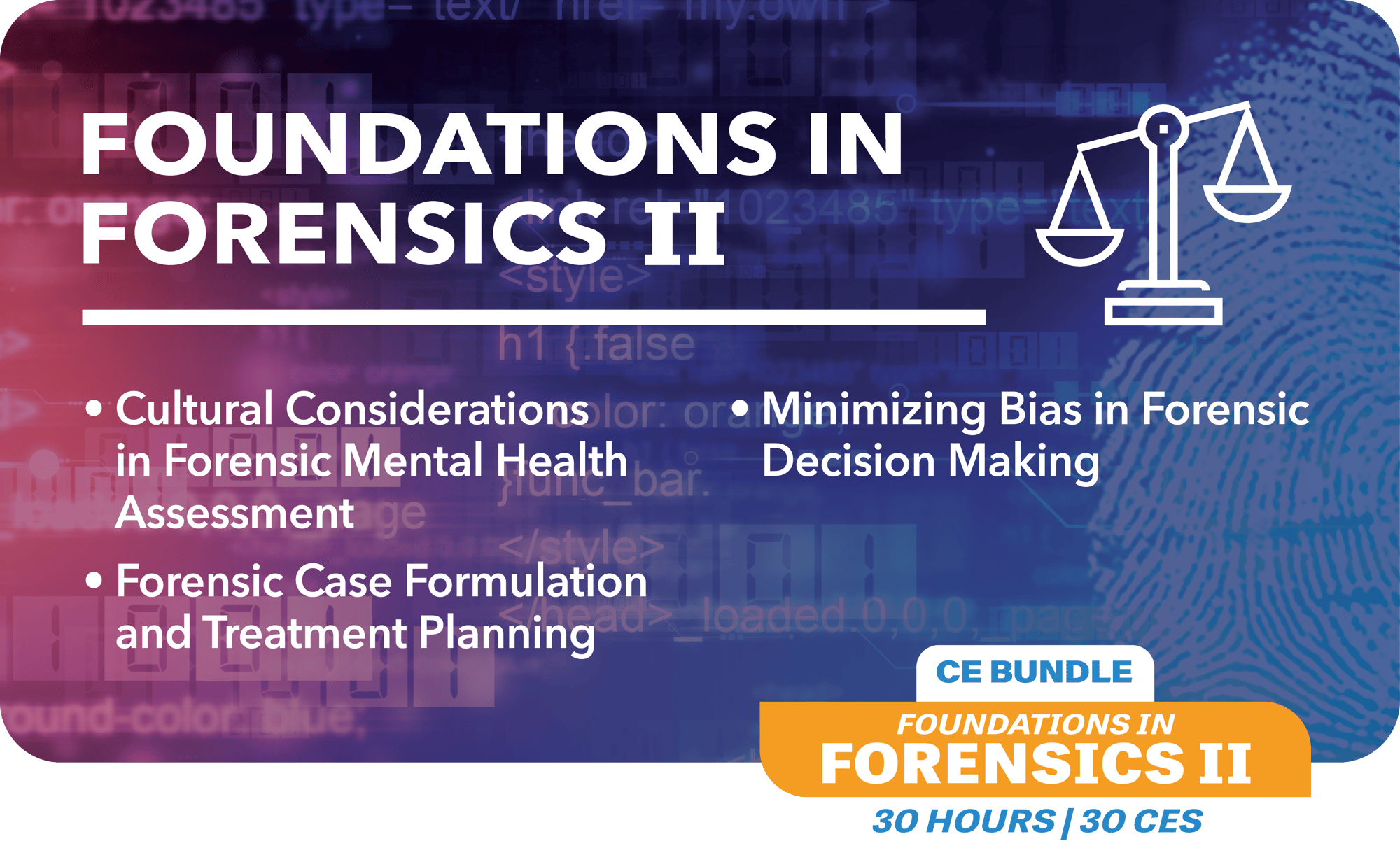
Cultural Considerations in Forensic Mental Health Assessment

10 Hours | 10 CEs
This on-demand professional training program on Cultural Considerations in Forensic Mental Health Assessment is presented by Amanda Fanniff, PhD. This badge-earning program can be shared digitally on platforms like LinkedIn or your resume and counts towards various certificates. Enroll to earn credit and share your new digital credentials with prospective employers and colleagues. This program counts as a foundational program in the certificates:
- Criminal Forensic Assessment Certificate
- Child Custody Evaluation Certificate
- Civil Forensic Assessment Certificate
- Juvenile Forensic Assessment Certificate
- Violence Risk Assessment Certificate
There is a clear ethical imperative for forensic evaluators to tailor their assessments to their examinees’ relevant identities. Mental health professionals have expressed the need for more specific guidance regarding culturally-informed forensic mental health assessment (FMHA) in several survey studies. Such guidance has begun to be published in the last four years, including a Delphi poll seeking to establish agreed-upon best practices for culturally informed FMHA (Fanniff et al., 2023).
The results of that study will be used to structure this training around five key components of FMHA:
- Developing and maintaining competence
- Practices for evaluations of examinees who have limited English language proficiency
- Referral and preparation for evaluation
- Clinical interview and use of assessment instruments
- Formulation
- Report writing
This program is designed for individuals at all stages of their professional journey—whether you're a recent graduate, early-career clinician, or an experienced professional seeking to deepen your expertise in forensic mental health assessment. While the course emphasizes criminal forensic examples, the content is also highly applicable to civil court evaluations. It is relevant for those working in a variety of settings, including private practice, university clinics, state hospitals, correctional facilities, and other contexts where forensic evaluations are conducted.

Intended Audience
This on-demand professional training program is intended for mental health and other allied professionals

Experience Level
This on-demand professional training program is appropriate for beginner, intermediate, and advanced level clinicians.

CE / CPD Credit
APA, ASWB, CPA, NBCC Click here for state and other regional board approvals.
Learning Objectives
Upon completion of this program you will be able to:

Identify at least two ethical guidelines that require mental health professionals to consider cultural considerations in conducting forensic mental health assessments (e.g., based on the American Psychology Association Ethical Principles of Psychologists and Code of Conduct, the Specialty Guidelines for Forensic Psychology, and/or the American Psychiatric Association Ethics Code)
Describe at least one recommendation related to working with examinees with limited English language proficiency and will be able to give an example of how to apply that recommendation
Describe at least one recommendation for selecting and interpreting psychological tests in a culturally-informed manner and will be able to give an example of how to apply each recommendation
Describe two research findings regarding whether specific assessment tools show bias across race, gender, or language identity
Describe at least one recommendation for culturally-informed forensic formulation and will be able to give an example of how to apply that recommendation
Describe at least one recommendation for culturally-informed report writing and will be able to give an example of how to apply that recommendation

Presented By
Amanda Fanniff, PhD
Amanda M. Fanniff, PhD, is an associate professor of psychology at Palo Alto University. Dr. Fanniff received her PhD in clinical psychology from the University of Arizona. She completed her clinical internship at Western Psychiatric Institute and Clinic at the University of Pittsburgh Medical Cente...
Curriculum
1. Foundations of Cultural Considerations in FMHA
2. Research and Recommended Practices
3. Evaluating Examinees With Limited English Proficiency (LEP)
4. Referral, Preparation, and Clinical Interviewing (Part 1)
5. Clinical Interviewing (Part 2) and Data Integration
6. Formulation and Cultural Context
7. Report Writing in Culturally Informed FMHA
8. Advocacy as an Ethical Imperative
Develop a Specialty Area of Practice
Transforming mental health professionals into experts

Expert Instructors
Professional training developed and delivered by the field's leading experts

CE Credit
Earn CE credit for meaningful professional training that will elevate your practice

Convenience & Flexibility
Learn at your own pace, from wherever you might be!