CONCEPT Continuing & Professional Studies at Palo Alto University
Free eBook: Master formulations, SPJ tools, and reasoning that courts trust
Even when stakes are at their highest.
When your evaluations inform decisions about civil commitment, conditional release, parole suitability, or threat management, consequences extend beyond the courtroom. Your opinions and formulations affect individual liberty, public safety, institutional liability, and your own professional credibility. Gain expert insights in this free guide.
Submit your email now to receive a link to download your eBook.
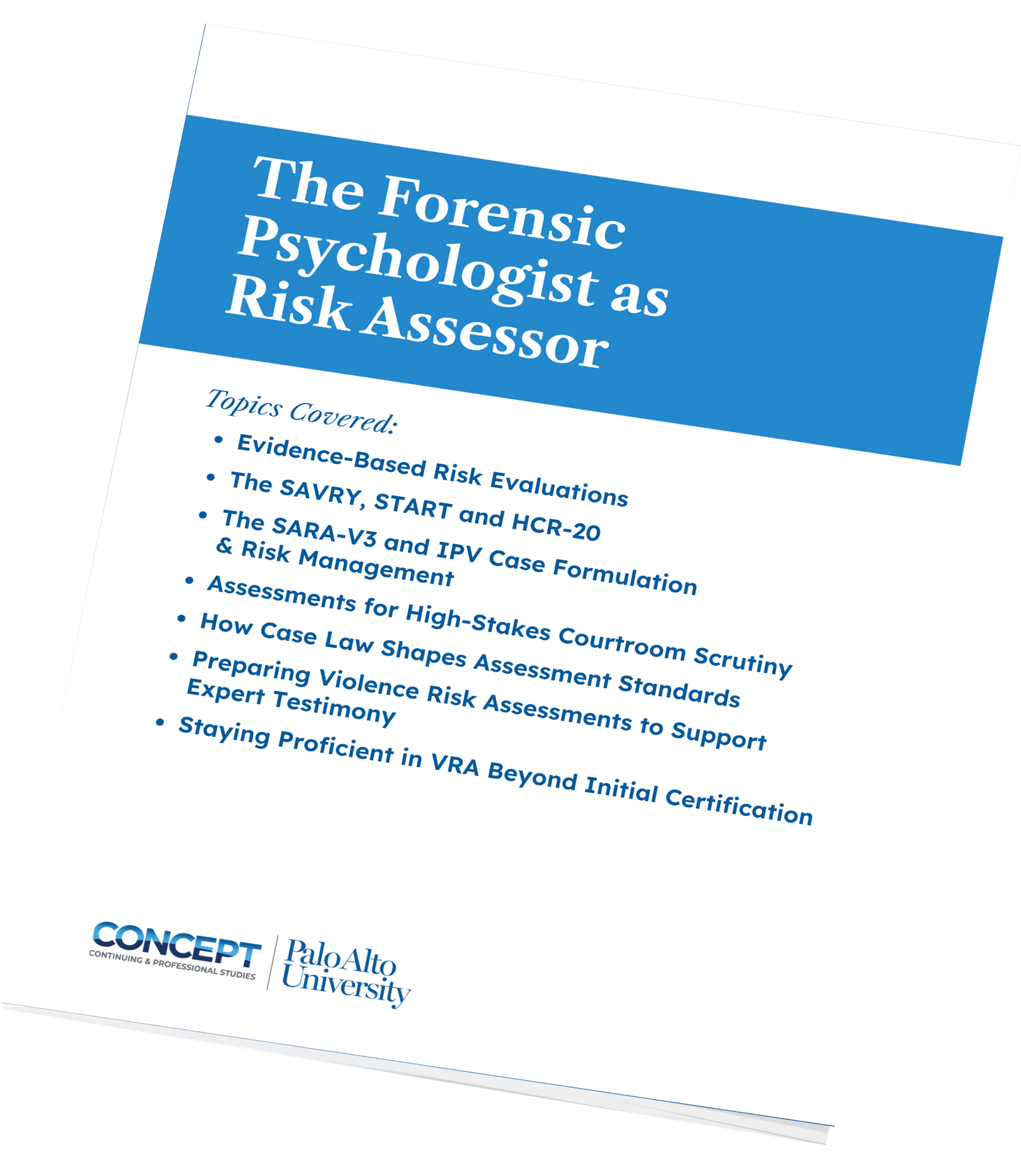
Key eBook Topics

Evidence-Based Risk Evaluations
Empirical research shows the value of structured assessment instruments in clinical judgment, leading to the development of numerous validated risk assessment measures.

The SAVRY, START
and HCR-20
Risk assessment practices used to rely on unstructured clinical judgment. The modern Structured Professional Judgment (SPJ) model provides evidence-based framework.

SARA-V3 & IPV Case Formulation
The SARA-V3 is less of a scoring instrument and more of a clinical reasoning scaffold to guide formulation of risk to a spouse, children, or related parties in terms of of future violence.

High-Stakes Assessments
Evaluators must adhere to the highest standards when the death penalty or life without parole is sought. Forensic psychologists ground opinions in methodology, communication and awareness of bias.
Violence Risk Assessment Certificate
10 Programs | 150 CE Hours | On Demand | $4,650
Learn the theoretical, empirical, and practical skills to reliably conduct forensic violence risk and threat assessments.
Describe the admissibility standards for expert evidence articulated by the Supreme Court of the United States, a 7-step problem-solving process to respond to ethical/legal dilemmas and the admissibility standards for expert evidence articulated by the Supreme Court of the United States
This professional growth opportunity allows for mastery of the specialty skills crucial for work with community mental health agencies, forensic hospitals, correctional facilities, state hospitals, and more. The certificate program spans 150 hours of CE-earning content across 10 programs.
➡️ Participants Learn To: Describe the principles of cultural competence in psychological evaluations.
➡️ Participants Learn To: Describe background information regarding the human mind and cognitive system.
➡️ Participants Learn To: Describe the various functions that reports and affidavits which summarize forensic evaluations serve. And much more.
64,000+ Enrollments
95+
Countries
550+
Programs
2,675+
CE Hours
404+
Organizations
CE Training
Leaders in Continuing Education
for Mental Health Professionals

Learn from Industry
Leading Experts
Gain expertise in a meaningful area you care about by the field's leading expert. Our platform offers flexibility to expand familiarity with varying specialties.

Flexible Learning Formats Live & On-Demand
We offer a wide range of customized, live and online courses to network with others while adding knowledge and new experience to your practice.

Practice Lifelong Excellence
Choose valuable programs that will propel your career forward, expanding your breadth of marketable skills and giving greater fulfillment in your job.

The CONCEPT Philosophy
CONCEPT Continuing & Professional Studies at Palo Alto University delivers advanced training for mental health professionals, with programs customized to individual learning needs. High caseloads, limited resources, limited time and budgets — we understand the everyday barriers to achieving the level of professional development you need.
With content curated by psychologist Dr. Patricia Zapf and our Advisory Board, we make training for developing skills, following best practices, and improving credibility. Our continuing education programs are accessible and individualized to fit every schedule so you can take your practice to the next level.
We Train Organizations of all Sizes